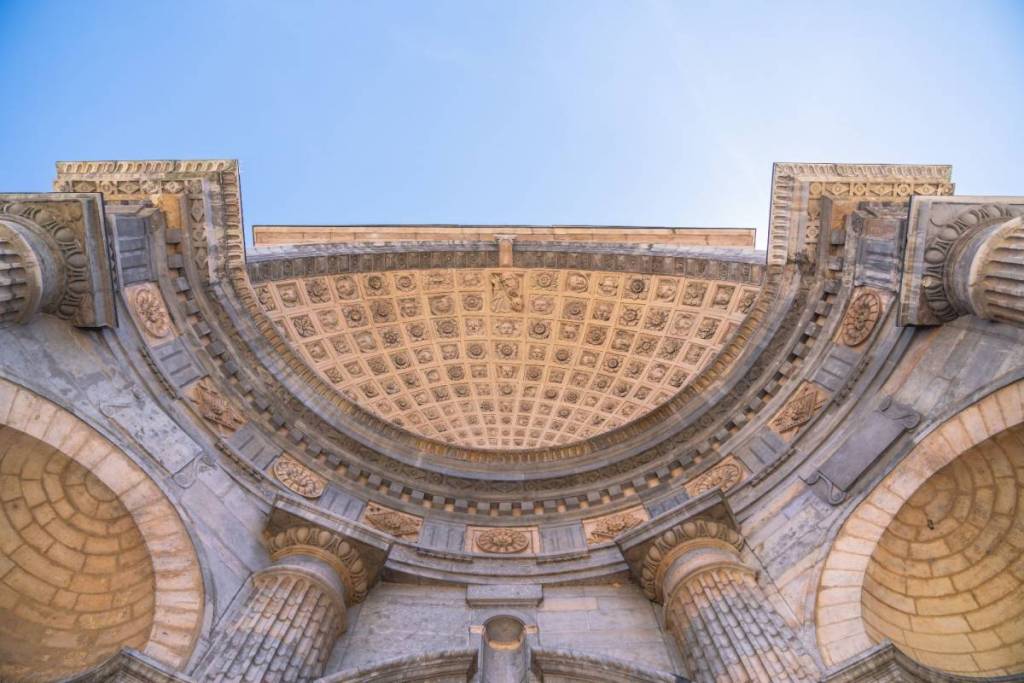

Thousands of us pass by it every day. And yet, few of us are aware of this very distinctive architectural feature. Just like the astronomical clock at Saint-Jean Cathedral or the spiral staircase, the treasures of our local heritage are hidden and, in a way, must be sought out. So, the next time you’re strolling through the Cordeliers district, between Place des Terreaux and Place des Jacobins, look up at the forecourt of Saint-Nizier Church to admire its magnificent carved portal!
Saint-Nizier Church and its constellation of sculptures
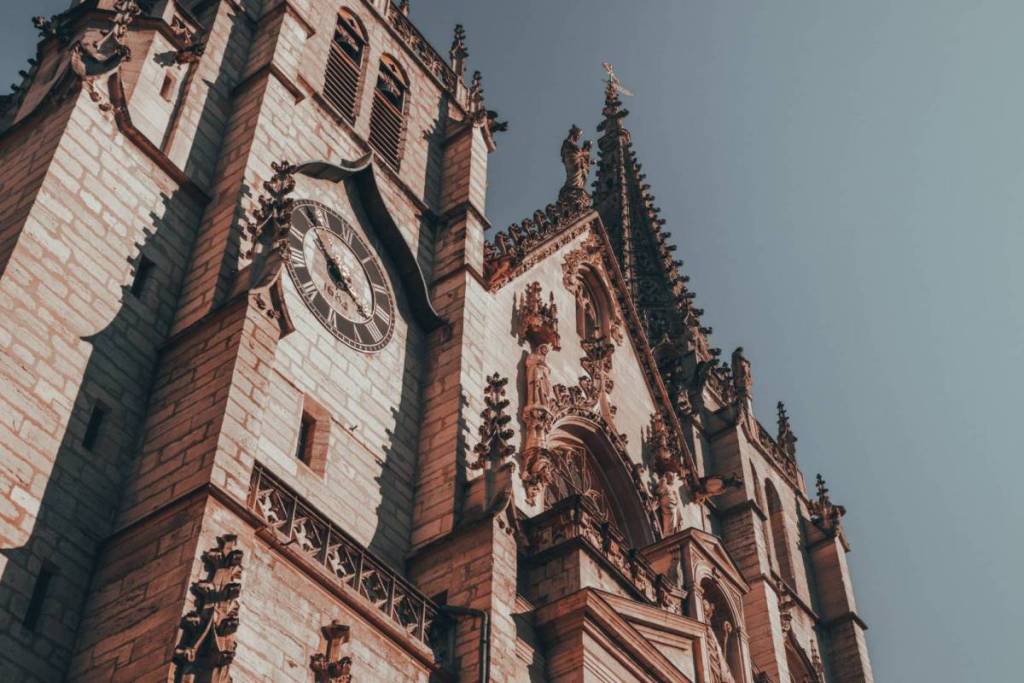
About a hundred angels and just as many flowers. This is what awaits you at the entrance to Saint-Nizier Church. This sculptural originality makes it a delightful curiosity to behold. You can admire 200 sculptures depicting a whole host of cherubs and a profusion of budding flowers. Be careful, however, not to strain your neck trying to count the sculptures one by one. We recommend spacing out your visits to make the experience last longer and avoid having to wear a neck brace. Just before summer, that would be a shame…
Saint-Nizier Church is an architectural gem in its own right. It features two asymmetrical spires, one dating from the 15th century and the other from the 19th century. Built primarily in the so-called Flamboyant Gothic style, the church has stood the test of time and, much like Ambronay Abbey, bears the marks of several eras. Without calling it an architectural patchwork, it remains a sort of giant mosaic, a witness to the passage of time.Construction began in the 14th century… it has seen a lot of Lyon!
Historic monuments: a history dating back to the French Revolution
Although 1840 is cited as the founding date of the designation, its history actually dates back to the French Revolution. Before 1789, most monuments belonged to the French crown or the clergy. Thus, following the Revolution, a concept of national heritage—which was entirely new at the time—had to be established. As early as 1790, the term “historic monument” was first used in connection with the demolition of the Bastille, but also in the context of growing vandalism by the French people, who were now “free” to appropriate these national treasures. What could be done? An entity had to be created to preserve our heritage. A department within the Ministry of the Interior was thus established in 1830.
In 1840, the first list of historic monuments was published, which included the Saint-Nizier Church, and it has been expanded over the years. Today, no fewer than 50,000 buildings are protected as historic monuments, along with approximately 300,000 movable objects—a testament to our incredible heritage that we must strive to preserve.