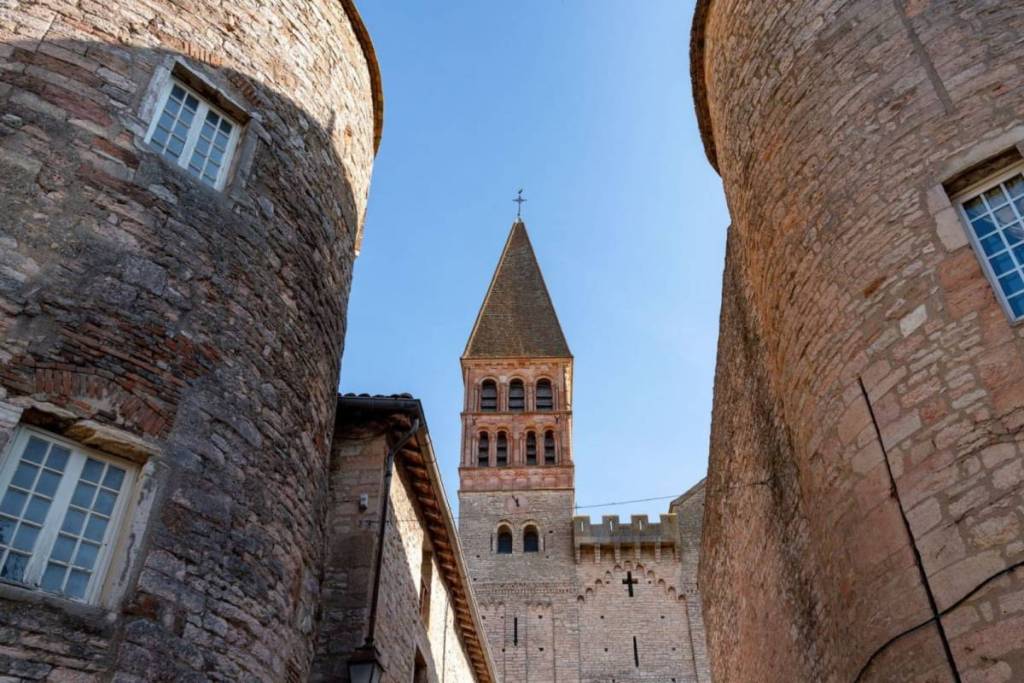

Let’s continue our famous tour of the Grands Ducs. This is a tour of buildings that deserve the spotlight simply because most of them have stood for over 1,000 years. After recently telling you about the Romanesque cloister of Salles-Arbuissonnas, the Brou Monastery in Bourg-en-Bresse, and Ambronay Abbey, let’s head north toward Tournus!
Tournus, City of Art and History
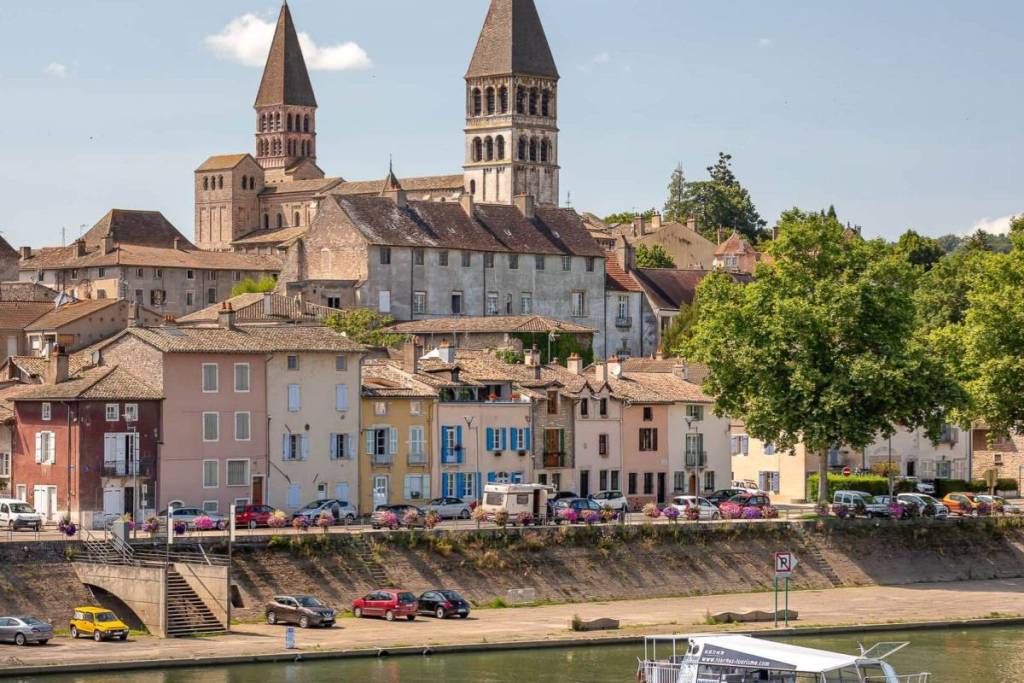
The charming town of Tournus draws its history from the banks of the Saône. It is, by extension, closely linked to the city of Lyon. Its architecture, with its colorful facades and flat roofs, strangely resembles the Drôme Provençale more than the Burgundian hinterland. Old houses dating back to the 17th century, along with historic mansions, the Town Hall Square, and its many restaurants complete the picture. Its location at the crossroads of Burgundy, the Jura, and the Beaujolais makes it a strategic hub for gastronomy and wine.
Its historic center invites you to stroll through the narrow cobblestone streets to enjoy a coffee in the market square, visit the Hôtel-Dieu and its apothecary, or explore its bicycle museum, the only one of its kind in France. Just like Semur-en-Auxois or Cluny, which are similar in size, it boasts a history stretching back thousands of years. In short, a town with a rich past.
Saint-Philibert Abbey in Tournus, a jewel of our heritage
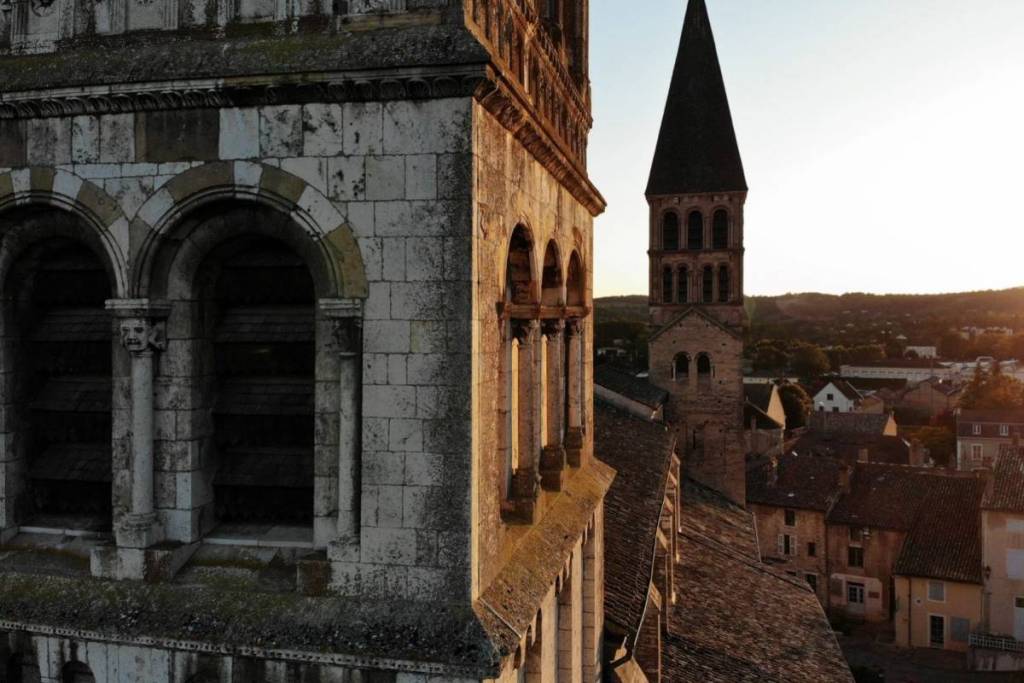
Just like the Church of Saint-Nizier in Lyon, Tournus Abbey was listed as early as 1840 on the very first list of historic monuments. That sets the scene. It is considered one of the oldest monastic centers in France since, as early as the late 9th century (in 875), the monks of Noirmoutier found refuge there, driven out by Norman incursions. It gradually became a Benedictine monastery. The construction itself dates back to the very beginning of the 11th century (1008) and was completed a century later, in 1120. Its Romanesque church, one of the tallest and most remarkable in France, has a vault height of 18 meters. Beneath its choir, the crypt rises above the tomb of Saint Valérien, martyred by the Romans in 178.
For 1,000 years, the abbey has thus weathered the tides of our rich history. Burned down, rebuilt, ransacked, expanded, then looted and renovated, the abbey’s history has been anything but a long, quiet river. But this tangle of events in no way detracts from the architectural richness of the site, which today makes it one of the most prestigious sanctuaries of Romanesque art in France.